
Economics
Economics EN
Course taught in English · Faculty of Organizational Sciences, University of Belgrade
Course information
| Level of study | Undergraduate academic studies |
|---|---|
| Language of instruction | English |
| Teacher | Prof. Sandra Jednak, PhD |
| Teaching assistants | Miloš Parežanin · Đorđe Cvetković |
| Textbook | N. Gregory Mankiw & Mark P. Taylor, Economics, 7th Edition, Cengage Learning EMEA, 2026 |
| Weekly schedule | Lectures and exercises over 13 weeks, with two colloquia |
Course aims and learning outcomes
Course aim
To introduce students to the basic concepts, principles and models of modern economics, covering both microeconomics and macroeconomics, and to build the vocabulary needed to follow economic analysis and policy debates in English.
Learning outcomes
- Explain how markets work using supply and demand analysis.
- Analyse firm behaviour across different market structures.
- Evaluate market failures and government intervention.
- Interpret key macroeconomic indicators: GDP, inflation, unemployment.
- Assess the effects of monetary and fiscal policy.
Course content
Lectures: Introduction to economics; supply and demand; consumer choice; costs of production; competitive markets and efficiency; government policies; public goods and externalities; market structures (monopoly, monopolistic competition, oligopoly, contestable markets); measuring national well-being and the price level; production and growth; unemployment; the financial and monetary system; open-economy macroeconomics; business cycles; aggregate demand and supply; monetary and fiscal policy; inflation–unemployment trade-off.
Exercises: Follow the lecture topics through numerical problems, graphical analysis, and the case studies.
Textbook
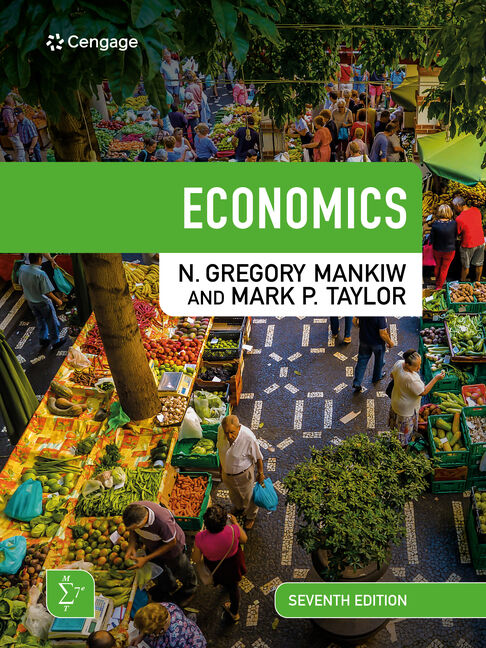
Economics, 7th Edition
N. Gregory Mankiw and Mark P. Taylor, with contributor Andrew Ashwin
| Publisher | Cengage Learning EMEA, Andover, UK |
|---|---|
| Year | 2026 |
| ISBN | 978-1-8050-3049-2 |
| Based on | Mankiw, Principles of Economics, 10th Edition |
| Coverage | 34 chapters in 13 parts |
The European adaptation of Mankiw’s text, with European examples and chapters on the EU, heterodox economics and sustainability. Students are expected to read the assigned chapters before each lecture and work through the Questions for Review at the end of each chapter.
Teaching materials
▸ Lectures 13 lectures · click to open or close
| Week | Topic | Chapters | Slides |
|---|---|---|---|
| Lecture 1 | What is economics? Thinking like an economist | 1–2 | |
| Lecture 2 | The market forces of supply and demand; elasticity | 3 | |
| Lecture 3 | Background to demand: consumer choices | 4 | |
| Lecture 4 | Background to supply: the costs of production | 5 | |
| Lecture 5 | Firms in competitive markets; efficiency of markets | 6–7 | |
| Lecture 6 | Government policies, public goods and externalities | 8–10 | |
| Lecture 7 | Market structures: monopoly, monopolistic competition, oligopoly, contestable markets | 11–14 | |
| Week 8 | Colloquium I (microeconomics, chapters 1–14) | — | See announcements |
| Lecture 8 | Measuring a nation’s well-being and the price level | 20 | |
| Lecture 9 | Production and growth; unemployment and the labour market | 21–22 | |
| Lecture 10 | Saving, investment and the financial system; the monetary system | 23–24 | |
| Lecture 11 | Open-economy macroeconomics; business cycles | 25–26 | |
| Lecture 12 | Aggregate demand and aggregate supply; monetary and fiscal policy | 28–29 | |
| Lecture 13 | Inflation and unemployment trade-off; supply-side policies | 30–31 | |
| Final | Colloquium II (macroeconomics, chapters 20–31) | — | See announcements |
▸ Exercises 13 exercises · click to open or close
| Week | Topic | Chapters | Material |
|---|---|---|---|
| Exercises 1 | Production possibilities frontier, opportunity cost, models | 1–2 | |
| Exercises 2 | Market equilibrium, shifts in supply and demand, elasticity | 3 | |
| Exercises 3 | Budget constraint, indifference curves, optimal choice | 4 | |
| Exercises 4 | Cost curves: fixed, variable, average and marginal cost | 5 | |
| Exercises 5 | Profit maximisation, consumer and producer surplus | 6–7 | |
| Exercises 6 | Price controls, taxes, deadweight loss, externalities | 8–10 | |
| Exercises 7 | Monopoly pricing, price discrimination, game theory | 11–14 | |
| Review | Preparation for Colloquium I | 1–14 | |
| Exercises 8 | GDP, real vs nominal GDP, GDP deflator and CPI | 20 | |
| Exercises 9 | Growth accounting, unemployment rate, labour market | 21–22 | |
| Exercises 10 | Loanable funds market, money multiplier, quantity theory | 23–24 | |
| Exercises 11 | Net exports, exchange rates, purchasing power parity | 25–26 | |
| Exercises 12 | AD–AS model, policy multipliers, crowding out | 28–29 | |
| Exercises 13 | Phillips curve; review for Colloquium II | 30–31 |
▸ Additional materials glossary, practice tests, data sources
Practice tests
Sample colloquium questions with solutions, in the format used on the exam.
Useful sources
- Eurostat – EU statistics used in textbook examples
- National Bank of Serbia – monetary policy and inflation data
- Statistical Office of the Republic of Serbia – GDP, prices, labour market
- European Central Bank – euro area monetary policy
Assessment
Students who do not pass a colloquium can take the corresponding part in the regular exam period. Results are published under Rezultati kolokvijuma.
Teachers and teaching assistants

Prof. Sandra Jednak, PhD
| sandra.jednak@fon.bg.ac.rs | |
| Office | A221 |
| Office hours | Tuesday, 16:00–18:00 |

Miloš Parežanin
| milos.parezanin@fon.bg.ac.rs | |
| Office | A119 |
| Office hours | Tuesday, 11:00–14:00 |

Đorđe Cvetković
| djordje.cvetkovic@fon.bg.ac.rs | |
| Office | A214 |
| Office hours | Tuesday, 14:00–17:00 |
Announcements for the English-language group are posted under Obaveštenja → Novosti. Please use your faculty email address when contacting teachers.